It was Australia’s entry into WWI that saw a young widow, Myra Taylor, brace herself as she stood at North Head on a windy night in 1915. There she tested her rayless, light-throwing device to see if it might benefit the Allies, given light just ‘appeared’ in the sky – minus a telltale beam to betray its origin.
Its reach was impressive, but there was no way for the inventor to measure the distance.
Reports soon reached her that the light had not only confused locals, but the crew aboard a ship way out to sea. The alarmed captain had contacted the lighthouse-keeper at South Head to ascertain what was happening. He was none the wiser.
Mrs Taylor had her answer: it had travelled a very long way. Point-to-point, the weird light with no tell-tale beam, had landed 700 miles away, she would later tell journalists.
Speculation grew, particularly among locals, as to its origins. But the kerfuffle abruptly ended when the Department of Defence, newly thrown into the world-war arena and clearly interested in the device, simply confiscated the plans and prototype.
Still, it was just a blip in proceedings for Mrs Taylor. She doggedly persisted with her inventions, despite by the department’s antics. While women everywhere were saying goodbye to their menfolk, she was busy filing patents for inventions to ease soldiers’ daily discomfort; give medics a superior way to bind wounds; and a new method of mitigating frontline injury and death.
The blatant confiscation of her ideas would become a familiar theme for Mrs Taylor, but this was not her biggest stumbling block. Her lack of education, her reputation as an eccentric, and clearly her gender, did not help. She was dismissed as an odd woman who tinkered away in her backyard shed – filled with chemicals, scientific apparatus, machines and other contraptions – all manner of materials from which she produced the stuff of dreams. Literally.
Sleep on it
As a child, Mrs Taylor developed a rare condition called somnambulant writing, which allowed her to focus on an idea as she slipped into sleep, and have an invention or problem solved by morning. While still asleep, she’d get out of bed and begin to feverishly record her ideas on anything suitable, including walls and bedsheets. Her scrawling included complex maths solutions, technical drawings, specifications, and very detailed plans.
However, by morning she needed a mirror to decipher the lot. She had written the words backwards, starting her notes from the right-hand-side of the surface.
“Rifle, shell, and machine-gun proof”
Though she sought no limelight, Mrs Taylor’s next invention attracted even more attention. Her Defence Fence had survived the long assessment process, from thousands of culled entries, following the department’s public shout-out for ideas.
The Defence Fence consisted of a series of two, steel shields with sturdy, coiled springs wedged and welded between them. The department pronounced it “rifle, shell, and machine-gun proof”. Despite the stellar endorsement and resultant media, it was confiscated.
It seemed ‘M J Taylor’ was discovered to be female and, moreover, was a bit of an oddball with a rudimentary education. Rumours that both these inventions were produced by the department lack foundation, though editors at the time translated their outrage to the page.
However, the department warmly greeted her “stitch-less button”, known as the press-stud today, and her “stitch-less hook and eye”, improving soldiers’ comfort with the ability to quickly don and doff the pull-apart fronts.
So, it seemed the department was happy with Mrs Taylor’s inventions, as long as she stayed in her allotted ‘domestic’ lane and did not veer into engineering traffic.
Early life and a rare gift
Maria Julia Welsh was born in County Cork, Ireland to a clergyman, Marcus, and the daughter of an Australian engineer, Harriett, though some reports cite Mrs Welsh as the engineer. Her family’s crest is more than 1000 years old, and her ancestry is filled with military men and Protestant clergy. Her lineage includes near-royalty, with the Reverend George chaplain to King William III.
Her father met and married her mother in New Zealand after he’d joined the wars between colonials and the Maori in 1850. The newlyweds returned to Ireland, but suffered a house fire which saw his relatives put them up in the “ruinous Bunratty Castle”, a 15th century, medieval tower house in County Clare which, at times, did not have a roof. It was here they lived ahead of making the arduous trip by ship to Adelaide in 1880, when Myra was two years old.
Following disembarkation, the family quickly learned that silver had been discovered at Broken Hill. The Welshes, bringing religion to the area, set up camp in the mining town. They opened St Peter’s School in nearby Silverton, where an eventual six Welsh children were educated.
At age 10, Myra startled her mother with her first invention, the self-locking safety pin. Seeing her mother’s reaction, Myra joyfully pronounced: “I can do something that you cannot do!” Sadly, no one thought to patent the ingenious device. Later, in what must have been an arresting, dejavu moment for her Myra, her five-year-old also presented her mother with a prototype. The little girl was unhappy that, no matter how she laid them out, her dolls never looked comfortable. According to the female-led, New Zealand newspaper, The White Ribbon, “she [had] affected a contrivance which a Patent Attorney pronounced ‘an ingenious invention worthy of a mature brain’.” Clearly, a patent had been sought.
Death sentence rejected
As a young woman, and likely due to the family’s proximity to the mines, Myra contracted lead poisoning. She slowly became bedbound and gravely ill, after the poison had reached her lungs. Her parents had taken her to a specialist in Adelaide, whose prognosis was dire.
But Myra rejected the assessment, developing an inhalation system, still seen in hospitals today. Her system included an apparatus to clarify seven, secret ingredients that, when combined in various prescriptions, forced into tablet form, then burned, the fumes would clear the mucous, kill bacteria, and clean and heal the lungs.
Within a week she was able to dress herself. Within three years, she was pronounced cured. Myra’s devotion to humanity was evident when she travelled to Victoria Hospital and Sanatorium in the Blue Mountains to treat desperately ill patients with her Membrosus Inhalation Treatment. For years she was inundated with letters from grateful patients.
At the time, she could not have known that her device was yet to become even more personal.
The dying Scotsman
1905 was a big year for 27-year-old Myra Welsh. She had registered one patent, designed another invention, and had met a young Scotsman, William Taylor. Her soon-to-be fiance was already showing signs of tuberculosis, or consumption, as it was called. Not long after the pair met, doctors had given him three months to live. Resurrecting her treatment, Miss Welsh began intensively nursing him. Within a year he had shown signs of great improvement, and they married.
The Taylors lived at 2 Cowles Road, Mosman, and had two children, Lavie Curtis and William Paterson Welsh. During Mr Taylor’s illness, a three-month-old Lavie contracted the illness. Her mother altered the prescription for the baby, then administered the treatment to both patients. Later, X-rays showed no sign Lavie had ever had tuberculosis.
Mr Taylor died in 1912; seven years after they met. His wife had gifted him two children, and much more time. By now, it had largely been Mrs Taylor’s patents, licences, and royalties that had kept the family financially stable.
After her husband’s death, the Taylors moved to Perth, Bondi, Paddington, then back to Mosman, settling at 27 Prince Albert Street.
The Music Man
In 1919, Mrs Taylor, aged 41, married William George Farrell in 1919 – an accomplished musician and director of the Empress Orchestra in the city. The couple had a son the following year: the much-lauded, child-prodigy violinist, George Welsh Farrell, who made his debut at a Sydney Town Hall concert in 1935, launching an impressive career.
Final home: 27 Prince Albert Street last sold on 8 March 2018 – the 61st anniversary of Myra Farrell’s death, and the dedicated date for International Women’s Day. Photo: Realestate.com.au
Twenty-four patents by 1915
With WWI still raging and Australian men still fighting overseas, the women’s workforce ballooned as women took on roles such as munitions factory workers, farmers, administrators, firefighters, and tram conductors.
Spurred on by the suffragette movement, and probably empowered in their male-dominated roles, women were fed up being strapped into their cage-like, never-laundered, bone corsetry and began to loudly demand comfort and practicality.
The corset had been worn in much the same format by Western women for 500 years. Over its life, the simple addition of lacing at the back, dialled up the torture. ‘Tightlacing’ to achieve the desired 17-to-19-inch (45-to-51cm) waist, caused displaced internal organs; broken ribs; collapsed lungs; bruised organs; breathlessness; dizziness and fainting; spinal problems; and chronic gastro-intestinal issues. It also stunted growth in children who – strapped into the corset as young as three years old – became permanently damaged.
However, it was still advertised as providing support, good posture, and gave women the appearance of being “more attractive, refined, and intelligent”.
Enter Mrs Taylor with her washable, boneless corset, probably best described in The White Ribbon article of March 1916: “The Camisole Stayette is a garment which is so constructed as to perfect a good figure and improve a bad one.”
Myra Taylor offered Australian lingerie giant Berlei the patent and a manufacturing licence. However, after expressing disappointment in their paltry, non-negotiable offer, this she rejected.
Once again, she had been duped by deceitful tactics. Berlei had set about designing a similar product. However, to counter this move, she ensured manufacturing, marketing and sales began in earnest in England, and these items were soon on sale in Australia, in direct competition with the yet-to-launch Berlei copy.
Mrs Farrell invented the sling for carrying a baby, like those in use today, freeing mothers to more easily go about their day. The natty knapsack, worn at the front of the body, prompted American commentary, relayed to Mrs Farrell by author Ruth Park, also of Mosman, which suggested the inventor had stolen the pouch idea from kangaroos.
In 1931, her Surfix facelift, which lifted the skin by “mechanical means”, and promised to do away with the aged look. Mrs Farrell rode the wave of sales that followed, increasing the rate of her advertisements, which brought editorial opportunities. These stated that the device “which she terms a face and muscle support” was “so simple” Mrs Farrell could not understand why no one had thought of it earlier.
“Her theory is that wrinkles and sagging occur as the result of tired muscles,” the story goes. “The face gets more work and is more exposed than almost any other part of the body.”
Mrs Farrell blamed “the aged look” on “undernourished cells.”
“If the strain is removed from the muscles through lifting them to their normal position, and thus resting them, the cell tissues will be built up again.”
The device was worn for several months at a time “for mild sagging”. It consisted of a rubber band which was attached to plaster pads at the temple, each shaped to support a specific problem muscle.
“The face does not sag more once the support has been removed, because you lift the muscles up to rest them,” Mrs Farrell explained. “You are not drawing tissues down and stretching them, but lifting the face up and releasing the strain while the renewed circulation rebuilds the broken tissues.”
One of her first inventions was a mechanical tracing machine to copy single-size, skirt patterns from books. With the aid of the tracer, seamstresses and tailors could now alter the size of the printed pattern, keeping true to the original design, by extrapolating the measurements to suit the wearer, ahead of transfer on to the fabric.
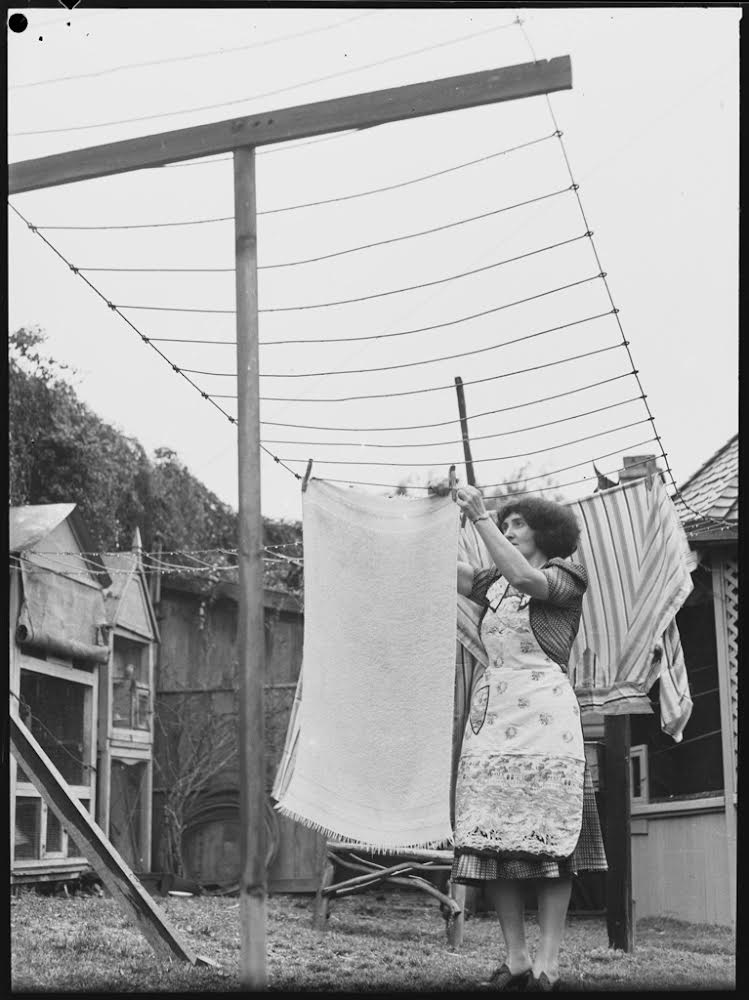
Mrs Farrell’s collapsible, foldable washing line could hold 280 feet (a shade more than 85 metres) on its 6-foot by 12-foot (3.6m by 1.8m) area. The clothesline, largely unchanged from today’s airers, saw the end of drying clothes on rocks, and a boon for flat dwellers.
She then turned her attention the permanent pole-to-pole, backyard clothesline, which wasn’t known for its stability given its ineffective load-bearing attributes. The line consisted of two poles anchored either end and hung with crossbars strung with rope east to west, and susceptible to collapse. The Farrell clothesline kept the two poles and crossbars, but under the design’s better weight-bearing properties, stability was now assured. She ran her rope north to south on shorter lengths, allowing laundry to be hung evenly, while the lines remained taut.
Myra’s Ointment for flour disease (caused by fungus-infested flour) was developed after a commercial baker and neighbour – admitting it was her last resort – sought the inventor’s help. By this time, she was covered in festering wounds, and severely depressed.
A test patch of the magic cream on her wrist began destroying the fungus within hours. As Mrs Farrell prescribed, the woman reportedly took a hot bath, patted herself dry, then applied the ointment liberally before wrapping herself in a sheet to sleep. This she did religiously and was soon cured.
It was she who invented the linoleum clip, a much simpler method of laying flooring with tacking.
She had success with her wheat sampler and weigher, and her machine for picking and packing fruit, which ensured fruit arrived at its destination unbruised and untouched by human hands. It was tested on the most vulnerable fruit, the mulberry.
Mrs Farrell’s growing list of patents included an automatic window, which opened and closed by pressing a button.
Her collapsible, rigid, folding hood could be made to fit any vehicle, which she fitted to a “perambulator” for presentation. These have been continuously in use since. The hood provided stellar protection from the elements and “free ventilation, an automatic air purifier and cooler, which can be adjusted to any requirements [with] its principle a form of condensation.
“The Patent Attorney pronounces this as a master invention, and states that hitherto there has been no record of any invention to make water run up a flat surface. Yet the contrivance appears simple and unobtrusive. It creates no wet or damp, nor any such discomfort,” The White Ribbon wrote, hailing the “contrivance” as a device to “dispense with the use of punkahs [a canvas-covered frame suspended from the ceiling and operated by a cord] and electric fans, etc.”
Another of her eye-popping inventions was light years ahead of its time. The “advertising apparatus” was described as a device which “automatically throws illuminated words into space” and would be “just as effective as the disappearing electric signs, and do away with all the permanent structure required for their maintenance.”
Mrs Farrell gave people the option of fixing their own worn shoes, developing an attachable sole. “[It] will fit any boot or shoe and requires no tacking on,” she said.
The Restful Railway Carriage Seat was designed so “… every traveller [is] assured of comfort during his journey.” It was at this stage, and after a limp response at home, she decided Australia was not the place where ideas were very welcome, and certainly not ideas derived by a woman. So, she took her comfy seat to America, skirting the process by having her patents registered there and in England. Only 11 of her 32 patent applications were well-received and registered in Australia.
Mrs Farrell bemoaned the obstacles she faced moving things along:
“It is so difficult to get anything done in Australia, and we are so slow and cautious about assimilating new ideas,” she told The White Ribbon.
“Mrs Taylor has just cause for complaint,” the editor said. “[It] took three years’ hard work for her to get her first patent made – the skirt and pattern maker. She also says that it is even difficult to get the Patent Attorney to listen to some of her new ideas.”
In one of the rare descriptions of Myra Farrell, the newspaper had this to say:
“One would expect to find the person responsible for all this ingenious work to be rather difficult, but Mrs Taylor is quite the reverse when one succeeds in making her talk of herself and her doings. Her manner is simple, kindly, and affable. In appearance, she is essentially feminine, very fair, and plump, with appealing blue eyes and a brilliant colouring, which comes and goes as she warms to her subject, and a soft, slow voice.”
While she still tinkered away at home in her shed and during her later life in Mosman it was apparent Mrs Farrell had ditched structured religion, eschewing a thousand years of family history.
The evidence comes partly through her subscription to the building of The Star Amphitheatre at Balmoral. A grand structure would cost of 16,000 pounds and was the vehicle through which followers would welcome the arrival to Australia of apolitical, psychic, humanist, guru, and leader of the Star of the East movement, Jiddu Krishnamurti.
The guru was 17 years old at the time and was eagerly greeted by those who’d forked out a small fortune to have their name etched into one of the amphitheatre’s stone benches, allegedly for posterity. The amphitheatre, which sat at the northern end of Balmoral above Edwards Beach, was demolished in the 1950s.
Mrs Farrell was well known in theosophical circles, where the Star of the East system of living had revived aspects of an ancient religion that identified with the occult, a fact which, no doubt, added to her eccentric affect.
In 1922, the Theosophical Society rented (and later bought) The Manor, in Iluka Road, Clifton Gardens. The 55-bedroom house, built in 1904, became the group’s headquarters, where many followers lived and worked. The Esoteric Section of the society is active and holds the deeds today. The Egyptian Rite still meets in the house’s basement chapel. The society has been in-residence for 101 years.
In a bid to spread the word, a radio station was licensed and launched at the property, and later became Sydney radio station, 2GB.
This movement was not the only cause to capture Mrs Farrell’s attention – and money. The visionary and utopian, William Lane, an Englishman who lived in Australia and New Zealand, enjoyed the patronage of Mrs Farrell in his quest to set up an “ideal society” in Paraguay. More than 2,000 subscribers paid 60 pounds for the purchase of a ship to take disaffected Australians to land where they could start afresh, as a communal society, and leave all the stultifying social issues behind.
Studying under a stage-scenery painter, Mrs Farrell also became and accomplished painter, after the style of the Impressionists. Though only the smaller of her paintings remain, the most famous was of the larger artworks, Seascapes, was painted around 1938.
Seascape by Myra Farrell circa 1938
The mummy’s foot
Somewhere along the way, Mrs Farrell ditched rigid, generational Christianity. Apart from her more humanist pursuits, such as funding for an “ideal society” for disenfranchised Australians and the big money spent supporting the Theosophical Society, she kept an Egyptian mummy’s foot as a talisman on her Mosman mantlepiece.
The provenance of the creepy item is unknown. However, in the 1920s, illegal archaeological digs had sprung up in Egypt, egged on by a healthy black-market for body parts and artefacts.
It had been said Mrs Farrell forbade her housekeeper from touching it. The woman reportedly had no complaint with the directive. After her death, the grisly item was relegated to the rubbish. It was discovered by the garbage-man, who took it to police for investigation, though records could not be found.
Scant details remain of Mrs Farrell’s inventions, though surviving, full records or diaries or notebooks must be in government archives. These were chased for this story but have yet have to be found.
Of course, the nature of gaining a patent required secrecy and careful vigilance lest one’s designs be copied ahead of a tick from the Patent Office. This may account for the elusive detail. However, Mrs Farrell’s domestic, personal, medical aids, and creams were eagerly drawn, photographed, or described, with some appearing in a rash of advertising following the launch of her boneless corset.
In 1916, a Queensland newspaper, The Warwick Examiner & Times, wrote of the upsurge in patent applications with a military bent. Mrs Farrell’s post-operative care surgical belt and binder – the original design helped hernia sufferers – featured prominently. The application carried testimonials from ten surgeons.
The newspaper listed some of the most interesting inventions and their inventors, yet reserved copious space with its own sub-heading for Mrs Farrell.
“Australian Woman Inventor
From the least expected quarter may come the most important ideas. This may be true of the inventions of Mrs Myra Juliet Taylor, of Sydney. Included in her 24 inventions is, strangely enough, a military appliance known as the Defence Fence. The military authorities reported after investigation that the fence is proof against rifle, shelling, and machine-gun fire.”
The story laments the paltry recognition received by Mrs Farrell.
“Perhaps it is Mrs Taylor who should have the honoured place among Australian inventors. She certainly deserves more recognition than the authorities have in many cases given her.”
In an interview with The Sun in July 1948, the journalist wondered whatever happened to her rayless light. In the article headlined, “Another war might do it”, Mrs Farrell said of her invention:
“Unfortunately, it was not properly investigated by military authorities in the first World War. It wasn’t used in the second World War, but I hope to have it accepted by England or America before the third World War. I am not bitter about Australia turning down my light. It will come into its own one day. The rayless light can be seen for 700 miles (1,127 kilometres). Because its rays cannot be seen, it is impossible for observers to say from what direction the light comes.”
Hinting that her nocturnal abilities were just a part of the package, Mrs Farrell simply said:
“I’ve always felt, as long as I can remember, that I could see and do things which other people could not.” Neither she nor her “people” understood her exceptional gift, so it is likely she never knew that the rare condition had a name.
“And it lay dormant for years,” she lamented, as if she had disappointed a world that expected so much more from Mosman’s almost famous genius.
Myra Juliet Farrell died at her Prince Albert Street, Mosman home on 8 March 1957, aged 79. Interestingly, she died on International Women’s Day. A thorough search of Australia’s notable people who have been immortalised via a plaque, statue, street name, other monument – or International Women’s Days list – revealed there is no such acknowledgement of Myra Farrell.
(This story first appeared [abridged] in Mosman Collective)
 Peekle
Leave a comment